On Wednesday 5th November a brief stroll at Botanical Gardens produced 5-6 Japanese Thrushes of both sexes, 1 skittish Chinese Blackbird, 3 Orange-headed Thrushes, 1 Blue Whistling Thrush.
It is great to
welcome Japanese Thrushes back to the park and their arrival comes at roughly
the same time as previous years. This timeliness never ceases to amaze me. Heard them (thin high-pitched tseeeee contact calls) before sighted them.
female Japanese Thrush
female Japanese Thrush
male Japanese Thrush
male Orange-headed Thrush To describe the back as grey makes it sound
very drab, but in good light it takes on a bluish hue.
I think that the migrant Orange-headed Thrushes seen in
northern Vietnam belong to the southeastern Chinese race melli with
a white wing-bar and two vertical facial dark lines - one below the eye and a
second on the auriculars.
Not much birding this week (26th Nov ->2nd Dec), the weather was awful. The terrible Hanoi winter has begun : cold, wet and GREY!
At the Botanical Gardens, I flushed an Eurasian Woodcock around the toilet area ! This guy was trying to hide itself behind a tiny bush. My second sighting of a Woodcock in this park. I also picked up a male Mugimaki Flycatcher.
Most of the White-tailed Robins or Fujian Niltavas spotted least week have gone - or have been captured by... blowpipe hunters (see the last photo of this post).
The park held small flocks of Turdus thrushes. Some male Japanese Thrushes with different patterns, whilst the others, all females or first-year birds, presented a significant identification problem and were not all identified conclusively. I did not found the solution in the guide books or on the Internet...
An adult male Japanese Thrush showing the "usual" pattern (i.e. the most encountered) with grey-blue mantle contrasting with black head
A black-backed male Japanese, with almost no contrast between head and mantle, and big black spots below (my second sighting of this pattern at Hanoi in 2 years, the other one here).
I am almost certain that this bird is coming from Northeast Asia. Japanese Thrush has different populations with plumage variations (curiously not covered in the guide books), birds breeding in China are a bit different from those breeding to the NE in Japan.
I suspect it's a 1st cy Japanese (heavily spotted below/flanks), but the strong warm orange down the flanks make me confused.
Well-demarcated streaky rather than spotted breast, faint spotted below... I suspect it's a 1st cy Grey-backed.
female White-tailed Robin
What is that ? From this angle, ID is a bit tricky
Hm hm.. a small blue patch in the neck : female Fujian Niltava
Blue Whistling Thrush. Nice bird, but crappy background.
male Mugimaki Flycacher. Regular passage migrant here.
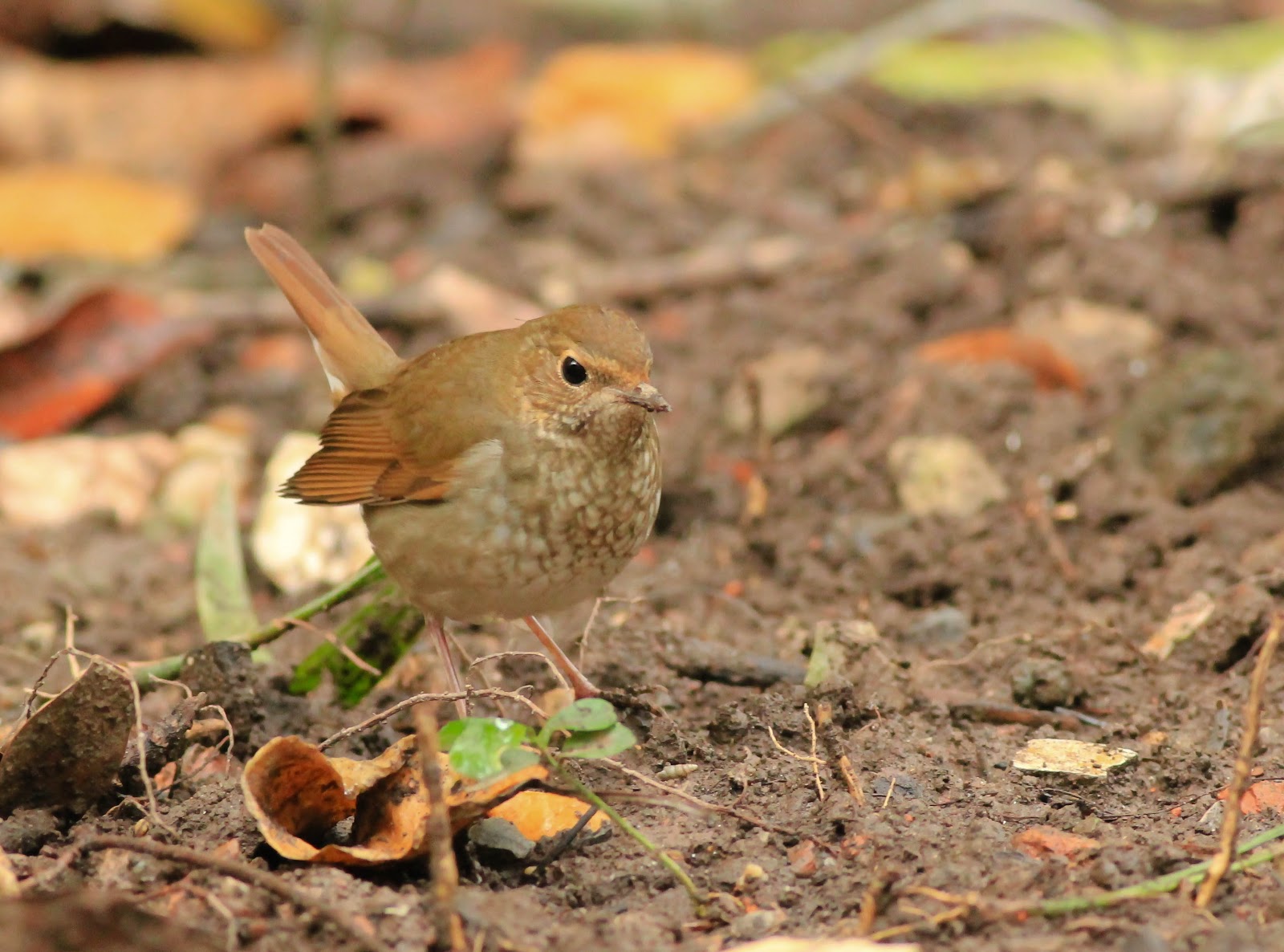
I spent one hour skulking around the toilet area, chasing this Rufous-tailed Robin. And if people saw me as a pervert, I don't care ! That is the price to pay for capturing close-ups of birds which are much more difficult to photograph in the forest.
It is really not too difficult to get nice shots of winterers/migrants in the urban parks because they can often allow much closer approach than the ones we encounter elsewhere.
Careful, it is slippery!
Olive-backed Pipit. Very common winterer.
We do not stop the progress ! Jivaro style hunting in the city !
They can hit a passerine at 20m - I took all my photos at less than 10m...
They do not use darts but soft balls. The objective is not to kill the bird but to stun it, and then put it in a cage.
Some lunchtime visits at the Botanical Gardens this week ( 19th -> 24th Nov.), my first ones of the autumn’s, produced a nice selection of migrants/winter visitors – maybe I should go there more regularly!
The highlights were 4 Fujian Niltavas (2 females, 2 males), 3 White-tailed Robins (2 males, 1 female), 1 Rufous-tailed Robin, 1 male Himalayan Bluetail, 1 Blue Whistling Thrush, 10+ Japanese Thrushes (some of them very tame, certainly not arrived one day before...), 2 skittish Chinese Blackbirds, 1 Large-billed Crow high in the canopy (patch tick # 111 / this number = Lenin Park + Bot. Garden – List here – If I forgot something, please tell me!).
Other notables included some Grey-headed Canary Flycatchers (the only species of Flys), a flock of 5-6 Silver-eared Mesias, Scarlet-backed Flowerpeckers (probably resident, seen or heard all the year), my first Olive-backed Pipits of the autumn, 1 Grey Wagtail, Seicercus Warblers sp., Yellow-browed Warblers…
Many of these guys were spotted around the toilets, which remains one of the best birding spot of the city centre!
I was very happy to see again many Thrushes in the park. It reminds me this fantastic winter 2010/2011 with sometimes 6-7 species of Thrushes the same day! The winter 2011-2012 was completely disappointed with very few Thrushes seen. I hope this one will be better.
For some of the images below, suggestions/remarks of the Thrushes's experts would be very welcome!
Female Fujian Niltava
Male Fujian Niltava
It uses the “sit and wait” tactic, dropping down onto preys on the ground from its perch.
Fujian Niltava is a regular sight at Hanoi in winter, but 4 individuals in the same place at the same time it is pretty amazing!
Rufous-tailed Robin.
An inconspiscuous species with few records in the Hanoi area (mostly in November), but likely to be under-recorded.
Male White-tailed Robin.
This species is assumed to be a montane resident, although there is evidence of some movements (not only altitudinal ones) during the non-breeding season.
Female White-tailed Robin
She appeared few seconds in a bushy corner as I was waiting for Thrushes. Shutter speed 1/10s. Even with the help of a tripod, no miracle...
Male Himalayan Bluetail
Large-billed Crow.
It shows a perfect plumage - especially no wear on the tip of the tail - so I assume it is a genuine bird and not an escapee or released individual.
2 males Japanese Thrush : one with a strong contrast between head and mantle/wings ; the other one (below) with almost no contrast. Why such a difference between 2 full adults individuals ? Different morphs/subspecies ?
"Hmm... let's see if there is not one or two plump worms here"
I think it is a 1st winter Japanese Thrush
Blue Whistling Thrush of the black-billed migratory race caeruleus (a possible future split). A rather common passage migrant in the Hanoi area.
A bit of video around the toilets (Flycatcher + BIG flies) :
One day trip to Mount Ba Vi last Sunday (26th December). In winter, this mountain can be very foggy and birding impossible. Sunday, the weather was nice, cold for sure but no mist, and the 3 famous peaks were perfectly visible as the photo shows (foreground : Đồng Mô lake):
I focused on the degraded forest and thickets around the restaurant area. Surprisingly, I saw many interesting species that we encounter generally in good forest, mixed with birds of more open habitats and forest edges. Many fruiting trees yielded flocks of Thrushes and other good birds.
Highlights : 2 Tristram's Buntings, 1 male Fujian Niltava and 1 Chestnut Bulbul (hard to believe I know, but good views...)
Seen also, among many others : - Barbets : Great (heard only), 1 Green-eared, 1 Blue-throated
- Thrushes : 1 Black-breasted, some Grey-backed and Scaly
- 1 Verditer Flycatcher
- 1 Stripe-Tit Babbler
- 1 Oriental Turtle Dove
- Flowerpeckers : 1 Scarlet-backed and 2 Fire-breasted feeding on the same fruiting tree
- very showy Orange-bellied Leafbirds, male singing and female
- 1 Chestnut-flanked White-eye in a flock of Japanese ones.
- Sunbirds : 2 Crimson, 1 Fork-tailed
- some Orange-flanked Bush Robins
- 1 Green Magpie sp Tristram's Bunting. I flushed 2 birds, non identified. One of them, more curious, reappeared in the thickets in which they had just disappeared, and observed me during long et nice seconds. Fire-breasted Flowerpecker male
Fire-breasted Flowerpecker female
Gorgeous Crimson Sunbird male
Blue-throated Barbet. I saw this bird 500m after the cactus garden, so at low altitude (300m). Each time I go to Ba Vi, I stop at this place which offer panoramic view on the valley and I have generally a contact with this species, moving in a degraded open forest. I don't understand why this bird which don't seems to have narrow habitat requirements (I mean good forest) is so rarely spotted elsewhere.
Scaly Thrush
A Japanese Thrush which seems to hesitate : Hmm, which one to choose ?
On the way back to Hanoi, I came across a flock of 20-30 Grey-capped Greenfinches at Đồng Mô lake, along the dyke (the northest one), feeding over grasslands grazed by cattle and perching sometimes on eucalyptus trees. Difficult to approach.
A nice birding trip with 2 lifers in the pocket (the Greenfinch and the Bunting), exactly one year after I began to interest myself in the vietnamese avifauna and twitched my very first local bird, it was a Robin Magpie...