Xuan Thuy (05.-06.10.2016)
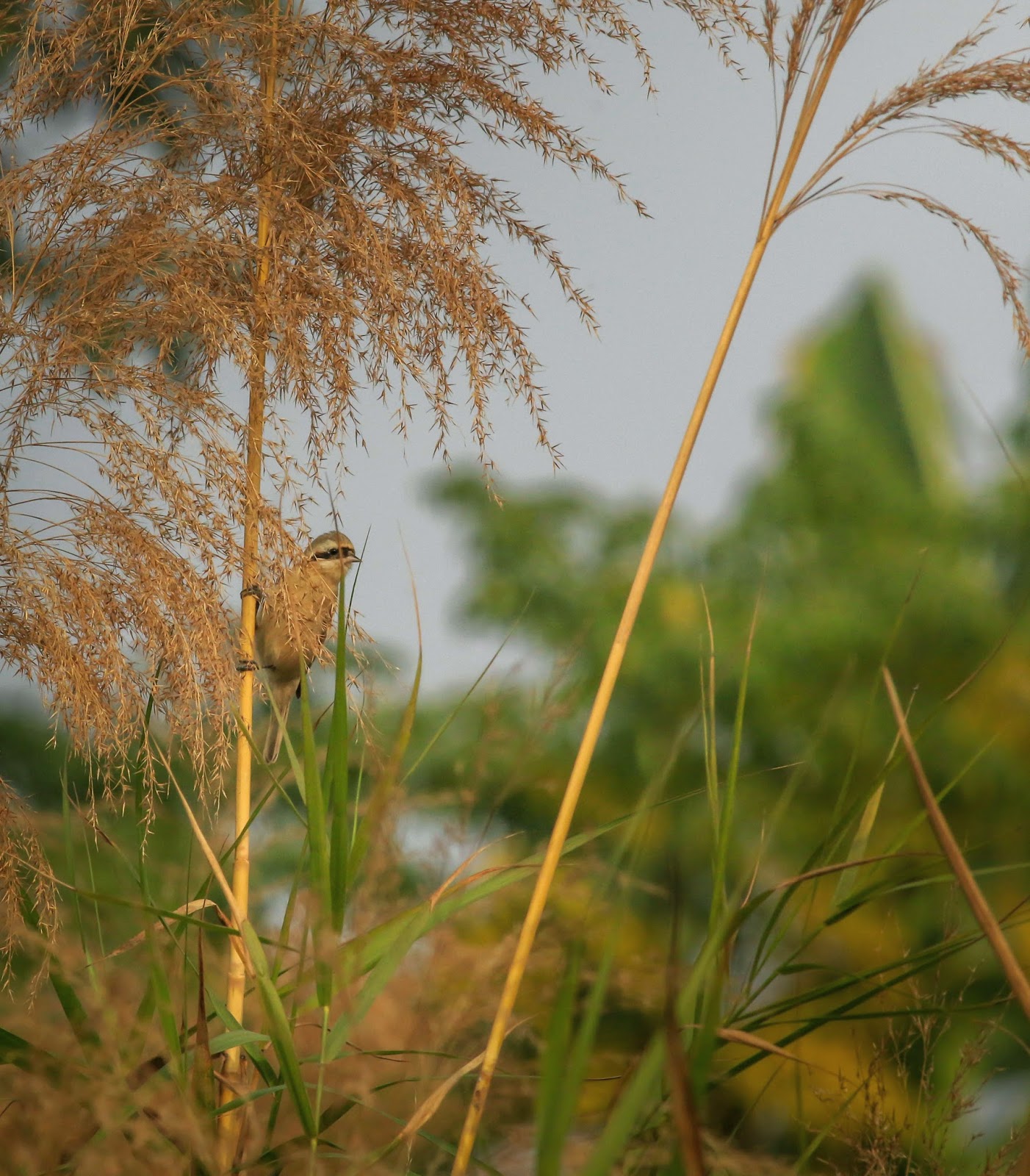
I went with my son for one night. We took the public bus from Hanoi My Dinh station to Giao Thien (3.5 h) and stayed at the park facilities. The first afternoon we birded around the shrimp ponds near the HQ and the next morning we went to Lu island to look for migrants. We were joined by NP staffers Truong and Dung and Tomas Najer, a Czech birder who was there for the week.
The shrimp ponds had many waders, including 100 or more Black-tailed Godwits and equally many Marsh and Wood Sandpipers, 20 or so Temminck Stints and other common waders in smaller numbers. In the evening we saw a single Oriental Pratincole.
The island was also good for waders, with 3 Terek Sandpipers and 2 Grey-tailed Tattlers the highlights. 20 + Pacific Golden Plovers and Grey Plovers were also nice.
Black Drongos were moving southwards continously and many Sparrowhawks (probably Chinese) with them. We had spent a lot of time to look for waders, so not that much time was left to search the island for resting passerines, and we had no really specacular sightings. Still good though, with Siberien Rubythroats, Siberien Blue Robins, a Red-flanked Blue-tail, Eastern Crowned Leaf Warbler and other Phylloscopus Warblers, several Chestnut-winged Cuckoos. We also flushed a Red-legged or Slaty-legged Crake but could not see the legs unfortunately.
The island keeps changing, shrimp ponds are now being constructed on its northern side, but there is still a strip of Casuarina trees which are usually good for migrant passerines, and the mud-flats on the western tip are becoming quite extensive. Still good for birding I think.
Full list Xuan Thuy
  |
| Little and Intermediate Egrets, Pond Herons, Wood Sandpipers, Marsh Sandpipers, Back-tailed Godwits |
 |
| Eastern Crowned Leaf Warbler |
 |
| Pacific Golden Plovers |
Sapa 11.-13.10.2016
Richard Craik and Le Quy Minh from Vietnambirding went to Sapa for checking out how suitable the new cable car would be for birding on Fansipan, and I joined them for the trip.
Having had a very nice trip to Fansipan in 2012 (see here and here), it was of course with very mixed feelings that I went back to the Fansipan of today. Indeed it was sad to see the state of the mountain: lots of attractions being built on the top (still mostly a construction site at the moment) with large stone stairs, several pagodas, a huge Buddha statue and a gigantic bell tower soon being on offer up there. The forest around the pylons of the cable car and the various ropeways for materials also looks pretty damaged from the construction works, and as usual, the construction waste is just tossed down the slopes.
Sapa town is a giant construction site now, with everyone busy preparing for the arrival of mass tourism in Sapa. Huge hotels are being built all over. Even at Tram Ton pass, a big new parking lot is just being finished.


In addition to the depressing sight of these developments came the bad weather: we had thick mist most of the time, which cleared a litte for shorter moments only. Birding was consequently very tough and we did not see many birds overall.
The first day, we took the cable car (600.000 dong and ca. 20 min) and then went down the classical hiking route (Tram Ton route) until the upper camp. The trail can be accessed from near the Buddha statute (the obvious trail leading down is well visible). With the construction noise around the summit, the slippery trail and bad visibility, it was not much fun. Birds were extremly quiet. Most of the tall bamboo on the slope near the upper camp (which used to be good for Laughingthrushes, White-browed Bush-Robin, Sickle-billed Scimitar-babbler) has died off and the young bamboo growth is still very low. We found a spectacular 6 species that day on Fansipan. Most common were White-browed Fulvetta around the summit area and Chestnut-headed Tesia in the remaining pockets of taller bamboo near the camp. Best area was the gully between the summit and the small pass between the camp and the summit (the point where we found Chestnut-crowned Bush-warbler in 2012 and where now is the pylon of a power line). Here we found, thanks to Minh's good eyes, Black-faced and Scaly Laughingthrushes, both very quietly moving through the vegetation. Scaly L. was new for me, so not all bad this day.
The other days we went on the lower part of the trail starting from Tram Ton pass (I went by myself of the first half day and all of us went again the second day). Actually we took the old Fansipan trail, which is apparently not used any more. That trail goes more less parallel to the new one and first leads over the tops of some smaller hills. The entrance is barred and the trail is sometimes a bit overgrown, though still walkable without much effort as far as we went (about 4h walk in birding pace). The staff at the gate may not let one go that way, but it can also accessed via the steps right next to the gate that lead up to a bell (from there a trail leads down to the old Fansipan trail).
It was again very misty most of the time, birds quiet and birding slow. But we found a few good birds, so in the end it was quite enjoyable. I was very luck to find Pale-throated Wren-babbler, which I could observe close up and even managed some nice photos. Very happy about that, as I missed this one on previous trips. We could not refind it on the same or other locations the next day, but I guess in spring and with better weather, it should not be difficult to find along that trail in bamboo understorey. That next day, we started with flushing a Wood Snipe on the first few meters on the trail. Later, we spent some time to stalk a pair of extremly skulking Slaty Blue Flycatchers, lifer for all of us. A few nice mixed flocks, frequent views of Tesias and also some good views of Great Barbets made for a good day in the end.
For visiting Fansipan in future, I guess the best way would still be the classical hike with a few nights spent on the mountain. Of course the hike up can now be saved and the trip be started from the top, but I think at least one night in each the upper and the lower camp would be needed to sufficiently cover the different parts. Without camping, the upper parts from the sumit to the upper camp, and the lower parts from Tram Ton pass can be accessed well. However, the area around the lower camp was also quite good in our 2012 trip and this cannot really be accessed well without camping there (it can easily be reached by hiking, but not at birding pace).
We did not explore other trails down the summit due to the very bad visibility. I think there is another hiking trail leading straight down from the summit (Sin Chai route) and I think this follows mostly the cable car. Access is probably easy as there are many trails from the construction works, but the forest may be quite disturbed. So not sure how good or bad this would be for birding. A further option could be to go down the eastern slope of the summit and continue along the ridge to the east, but not sure if there are any easy trails there. Something to explore in better weather.
Getting to Sapa: We took the new highway to Lao Cai, and it was the most relaxed drive I ever had in Vietnam, hardly any cars (and no bikes) on the road. Took us 5 hours from Hanoi downtown to Sapa. Much quicker than the train. Plenty of buses now also use that road.
Full lists:
- Fansipan
- Tram Ton
 |
| White-browed Fulvetta |
 |
| Pale-throated Wren-babbler |

Tam Hai (Quang Nam) 15.-18.10.2016
Tam Hai was a beach trip with the family. Tam Hai is an island at the river mouth of Truong Giang river and can be easily reached from Chu Lai airport (2 h drive from Danag). There is a nice resort and they had a good low-season discount, so we went there. A good choice (despite the not so great weather), as there were plenty of birds around. Just around the resort I could observe black and white Reef Herons, Whimbrels, Kentish Plovers, Greenshanks, Greater and Lesser Sand Plowers. In the Casuarina scrub around the resort, there was a noisy flock of Masked Laughingthrush. At night, I saw a Boobook hunting over the shrimp ponds behind the resort. Probably Brown Boobook, but I can't exclude Northern. The breast had clear long streaks, isolated dots were only on the lower belly, no obvious heart shapes, but not sure if they were teardrop shapes. A migrant Northern Bookbook could be possible at that location I think, in particular with the bad weather the previous days.
At the beach near the resort, there were many more plovers, including White-faced Plover. I also saw a Red-necked Pharalope briefly resting at a puddle on the beach and then flying onwards. A passing Amur Falcon was another great sighting at the same spot. Views were a bit distant, but its light flight and frequent howering were quite disctinctive.
Full List Tam Hai


 |
| Greater Sand Plover / White-faced Plover / Kentish Plove |
Most of our time was spent in Hanoi, so I could also do some Hanoi birding in the Botanical Garden and the current favorite of Hanoi's birders, Vuon Nhan.
No real spectacular sightings (the best time seems to be September, seen the few previous posts here), but still plenty of birds and very enjoyable breaks from city life.
On my last visit I saw a Black-headed Gull on the river near Vuon Nhan. New for my Vietnam list ;)
Lists:
- Botanical garden, 3.10.
- Vuon Nhan, 4.10.
- Vuon Nhan, 21.10.
 |
| Vinh Tuy bridge seen from Vuon Nhan |
 |
| Wryneck |
 |
| Black-headed Gull |