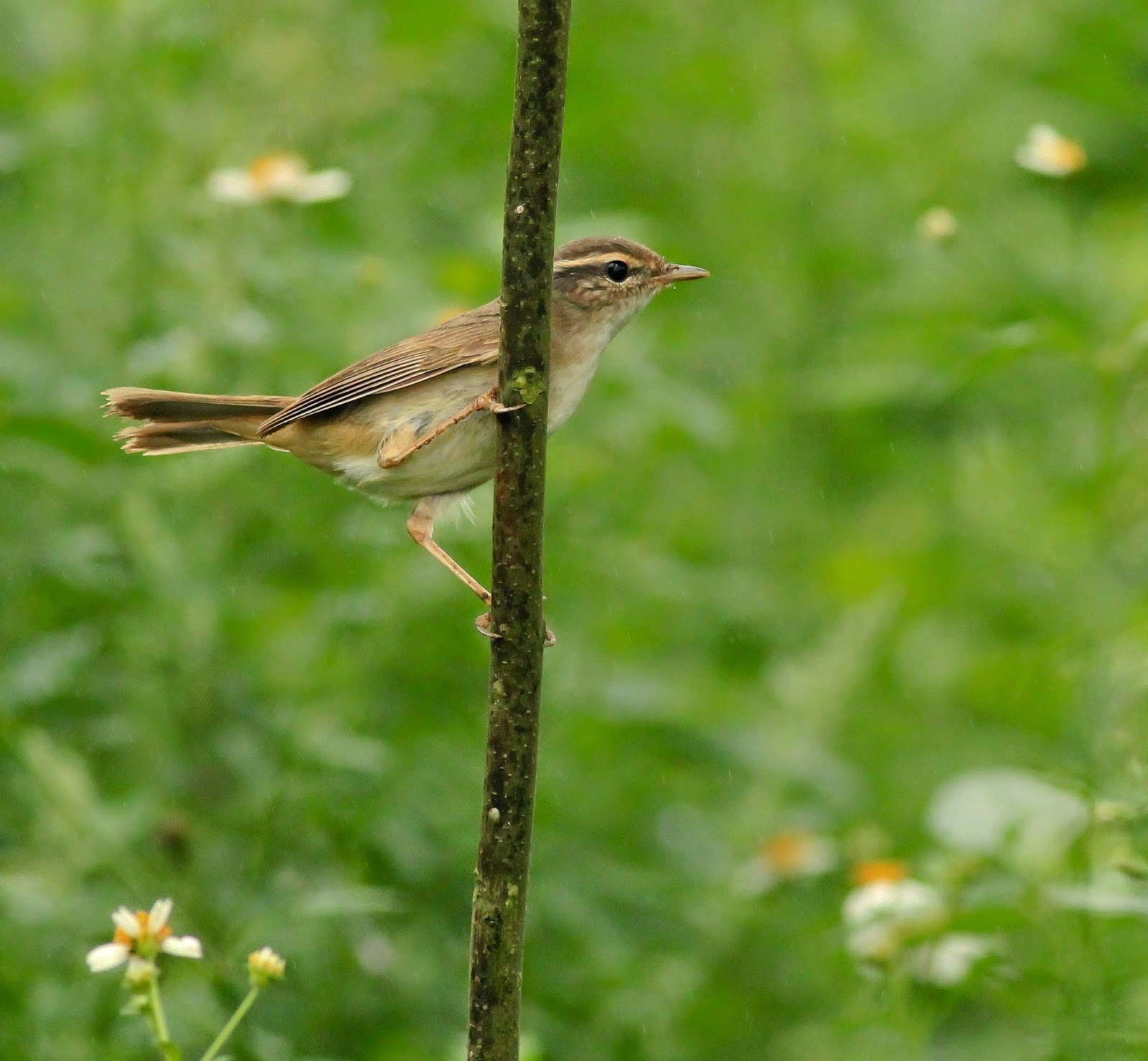
Male Green-backed Flycatcher, Red River
Island, April 13th (photo by Hung Le).
Almost daily coverage
of the island this week resulted in a total of 115 bird species seen. I was often joined in the field by Joy Ghosh and Hung Le, and between
us we managed to find an excellent array of migrants during one of the very
best weeks of the year.
At the same time as the birds pour through,
local people have been doubling their efforts to destroy all remaining
fragments of “natural” woodland on the island. The north wood has been
decimated, with virtually all of the best trees now gone (although the
non-native eucalyptus trees – which are fairly useless for birds – have been
left standing). Much of the grassy understorey has also been cleared. It seems
likely that the north wood will barely be worth visiting in another week’s
time. A sad end to what was until very recently a splendid habitat and refuge
for birds.
Simultaneously, a strip of good habitat at the
far south of the island is currently being bulldozed, and its imminent
disappearance seems inevitable. The “middle wood” is now the largest expanse of
remaining forest, but for some inexplicable reason it doesn’t seem to be very
popular with the birds, perhaps because of its location in the center of the
island away from the river.
On a more positive note, hunting pressures
seemed lower than usual, with no mist-netters encountered and just a few munia
traps here and there (I released any birds I found in them). Hopefully most of
the migrants using the small patches of remaining forest this week were able to
pass through this dangerous area unscathed.
Notable sightings on Red River island from my
seven visits between April 8th-15th included the following:
Japanese Quail – one flushed from the
overgrown field next to the north wood on 12/4.
Jerdon’s Baza – three over on 11/4 and
two on 15/4, corresponding with peak passage of this species at Tam Dao.
Pied Harrier – an adult male flew north
on 13/4.
Japanese Sparrowhawk – two sightings of
single birds.
Ruddy-breasted Crake – one flushed in the
overgrown field north of Bai Da on 8/4.
Oriental Pratincole – one flew north on
11/4.
Wedge-tailed Green Pigeon – one in the
north wood on 12/4, in exactly the same place as two birds on 22/3.
Chestnut-winged Cuckoo – one glimpsed in
the north wood on 12/4, followed by excellent views of another along the
western edge of the island on 14/4.
Large Hawk Cuckoo – one seen and
photographed near the north wood on 12/4.
Hodgson’s Hawk Cuckoo – one seen very
well at the middle wood on 11/4.
Oriental Cuckoo – one at the far south of
the island on 14/4.
Northern Boobook – one in the north wood
on 9/4.
Grey Nightjar – one in the north wood on
11/4, and perhaps the same individual seen and photographed by Hung Le on 13/4.
Black-capped Kingfisher – up to two seen
on three dates.
Dollarbird – one at the southern tip of
the island on 11/4, and another north of Bai Da on 15/4.
Eurasian Wryneck – one on 13/4.
Black-winged Cuckooshrike – two on 11/4.
Black-naped Oriole – one at the north
wood on 13/4 and 14/4.
Hair-crested Drongo – at least 17 on
11/4, with smaller numbers on other dates.
Racket-tailed Treepie – one along the
western edge on 14/4.
Pale-footed Bush-Warbler – three on 8/4
and two the following day, located by distinctive song and also seen on several
occasions.
Radde’s Warbler – one in the north wood
on 14/4.
Pale-legged Leaf Warbler – one in the
wood north of Bai Da on 15/4.
Eastern Crowned Warbler – one seen daily
in the north wood from 11/4-13/4.
Grey-crowned Warbler – easily
recognisable call heard in the north wood on 9/4, but not seen.
Other seicercus warblers
seen on several dates during the week didn’t call and therefore could not be
reliably identified.
Masked Laughingthrush – sadly only one
bird apparently remains from the 4-5 individuals present last month.
Black-throated Laughingthrush – one in
the middle wood on 11/4 may have been an escapee.
Yellow-rumped Flycatcher – up to three on
four dates during the week, mainly gorgeous males.
Green-backed Flycatcher – adult male
photographed in the north wood on 13/4, the first record of an adult male for
Vietnam.
Orange-headed Thrush – one in the north
wood on 14/4 was probably the same bird photographed by Hung Le the previous
day.
Eyebrowed Thrush – small flock of up to 7
present daily around the north wood from 8/4 to 11/4.
Grey-backed Thrush – one at the far south
of the island on 14/4.
Yellow-breasted Bunting – long-staying
adult male still at cornfield along western edge on 9/4 but not since.
Chestnut Bunting – female-type with above
bird on 9/4.
In addition, a selective list of regular
migrants and resident birds seen during the week included the following:
Oriental Honey-Buzzard, Grey-faced Buzzard, Barred Buttonquail, Oriental Turtle
Dove, Asian Koel, Lesser Coucal, Germain’s Swiftlet, White-throated Kingfisher,
Burmese Shrike, Ashy Drongo, White-throated Fantail, Black-naped Monarch,
Red-billed Blue Magpie, Grey-headed Canary Flycatcher, Claudia’s Leaf Warbler,
Thick-billed Warbler, Black-browed Reed Warbler, Asian Brown Flycatcher, Hainan
Blue Flycatcher, Hill Blue Flycatcher, Blue-and-White Flycatcher, Mugimaki
Flycatcher, Bluethroat, Siberian Rubythroat, Citrine Wagtail, Red-throated
Pipit, Olive-backed Pipit, Richard’s Pipit, Oriental Greenfinch and Little Bunting.