Welcome to Vietnam Bird News

Bird news from Vietnam, from Vietnam's resident and visiting birders.
Showing posts with label Da Lat. Show all posts

7 February 2014

Ta Nung Valley (Da Lat) - 3, 4 and 5 February 2014


My previous visit at Da Lat was in 2001 when I (Sébastien Delonglée) was traveling by bicycle. I remember a quiet town with old French colonial buildings across rolling hills. Thirteen years later, I discovered a bustling and noisy city. I just did not recognize it. Visiting “the City of thousands flowers” during Têt (Vietnamese New Year) holidays is not the best idea if you like quietness…

I must say that I came to Da Lat not only for birds. My wife accompanied me, and she loves flowers... I did morning birding and the afternoon was devoted to 'tourism' (I hate this word)... I birded Ta Nung valley three mornings. Three days of blue skies and glorious sun!

The Ta Nung valley (more exactly the place called "Di Nong Trai") is one of the most popular places for birdwatching near Da Lat. It only takes15-20 minutes by motorbyke from the city center. This site holds a large patch of remnant evergreen forest where many of the Da Lat specialities can still be found. It has been bought by a company planning to make an 'eco-tourism' (I also hate this one) resort and there has been some preliminary construction works. There is fence and a locked gate but the caretakers allow the birdwatchers to enter. Just need to give them a small amount of money to smooth things. I found the site very birdy at each visit. I even can say that the birding was better than any other place I have been to in Vietnam!

Poor quality shot at dawn of White-cheeked Laughingthrush. The white tail tips are very obvious in flight

Two mornings, I stumbled across big flocks (20-30 ind.) of restricted range White-cheeked Laughingthrushes even before I got to the entrance of the site, allowing prolonged great views. The first time the flock crossed the road in front of me. The second time, I found it below the road, in pines and thickets. I tried to approach a flock and flushed a Nightjar sp. At the same place, I had also great view of a small party of White-browed Scimitar-Babblers and a lone Eurasian Jay (of the subspecies leucotis, with a black cap and a wide black moustachial band). I heard some Greenfinches – probably Vietnamese G. but never made contact with them.

Leucotis Eurasian Jay

A few meters after the gate, near the caretakers’ house, I ran into 2 wintering White-throated Rock-Thrushes, a male and a female. I also spotted there a nice male Mugimaki Flycatcher. The dirt road goes down through a mix of pine forest, thickets and open broadleaved forest. I hit there a mixed flock of Black-crowned Parrotbill (split from Grey-headed), Blue-winged Minla (which I hardly recognized: subspecies orientalis, without blue crown/wings unlike the race occurring in northern Vietnam. A potential split apparently), beautiful Rufous-backed Sibia of the endemic non-rufous-backed eximia subspecies (potential split also), Maroon Oriole...


 White-throated Rock Thrush, male & female. Hid behind a bulldozer to take these pictures!

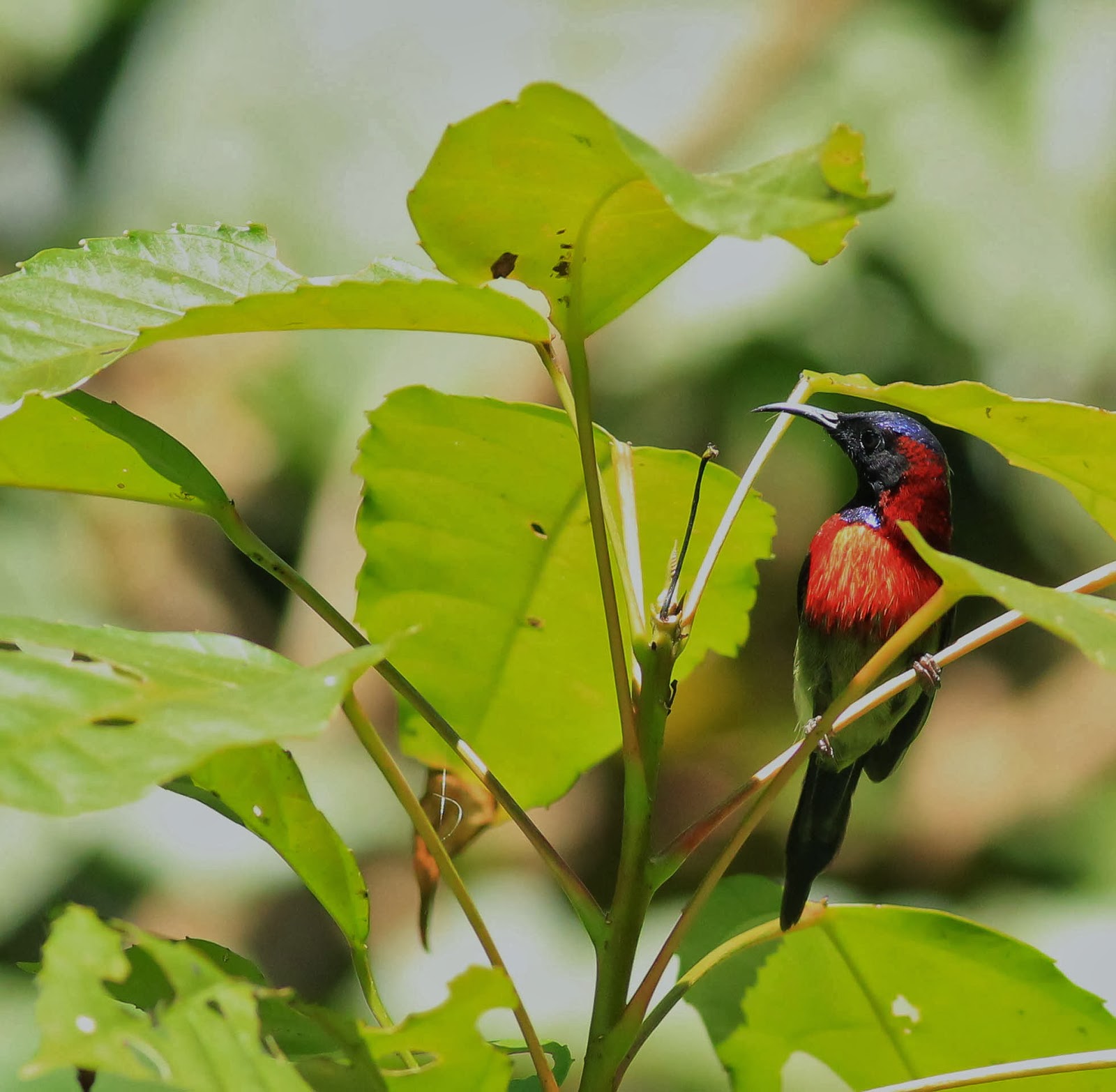
Good numbers of stunning red-breasted johnsi Black-throated Sunbirds (potential split) were feeding on trackside bottlebrush trees along with Mrs Gould’s Sunbirds. I had also a Black-headed Sibia (of the local race robinsoni, with broad white eyering and white ear-covert streaks) in the same trees, feeding on the same flowers.

Grey-eyed Bulbul

Some Annam Barbets (split from Black-browed) were feeding on various fruits, a nice Blue-bearded Bee-eater sat at the top of a dead tree, with a dozen of Thick-billed Green Pigeons. Also good was a male klossi Blue-throated Flycatcher. A calling Bay Woodpecker was tracked down. Many Verditer Flycatchers and Ashy Drongos were doing lots of hawking for insects from the pine trees. The latter seemed to be resident race bondi. I had also a great selection of bulbuls, which included Black, Red-whiskered, Black-crested, Mountain, Sooty-headed (with yellow vent; in northern Vietnam, I only saw the red-vented form), Ashy, Flavescent and Grey-eyed Bulbuls.

Flavescent Bulbul

Mountain Bulbul

Black-crowned Parrotbill, split from Grey-headed


 It did not take long before I spotted the local star i.e. the Grey-crowned Crocias! A lone individual foraging slowly in denser middle storey. This area is probably the best site for this rare endemic. This species was first described by a Swedish aristocrat, Count Gyldenstople, in 1939 from three specimens collected at an unknown locality by young adventurer Bertil Bjorkgren. For over 50 years there were no further records until it was rediscovered by Jonathan C Eames, Le Trong Trai and Nguyen Cu at Chu Yang Sin National Park in 1994. The Grey-crowned Crocias is one of the 13 Vietnamese endemics.

 Blue-winged Minla, subspecies orientalis 


At the valley bottom, upstream of a dam, begin a short (ca. 200m) trail. Below the dam there are also short trails but more or less overgrown. A pair of Slaty-backed Forktails showed extremely well on the stream. At the end of the longest trail I had good views of the elusive Indochinese Green Magpie and a stunning male Large Niltava. In the same area, I bumped into a small party of Orange-breasted Laughingthrushes, another Vietnamese endemic. Incredibly, they stayed a dozen of seconds a few meters away, allowed me close-up shots. Unfortunately all the 30 frame-filling pictures I got were badly underexposed. Wrong settings (took damselflies shots with another lens few minutes before)! Argh, beginner's mistake, hard to swallow!!!... 

 Thick-billed Green Pigeons enjoying the glorious morning sun at the top of a dead tree

 Mrs Gould’s Sunbird feeding on bottlebrush tree

Black-throated Sunbird of the local race johnsi 


I ran into many feeding mixed flocks with Lesser Racket-tailed Drongo, Grey-cheeked Warbler, Grey-headed Canary Flycatcher, Mountain Fulvetta, White-bellied Erpornis, Rufous-backed Sibia… In one of them, I saw my second Grey-crowned Crocias.

During a well-earned break along the stream, a calling Wren-babbler appeared briefly in the open few meters away. I clinched the identification after playing the tape: Pygmy Wren-babbler. I also heard a singing Tesia, another tiny understorey inhabitant, which turned out to be the Grey-bellied. Another individual foraging in the open was seen very well 50 meters below the dam. 

 Black-headed Sibia of the local race robinsoni

Other species noted: House Swift, Bar-winged Flycatcher-Shrike, Olive-backed Pipit, Scaly-breasted  Munia, White-throated Fantail, Green-billed Malkoha, Asian barred and Collared Owlets (heard), Red-vented Barbet (heard), Long-tailed Broadbill, Burmese Shrike, Indochinese Cukooshrike, Scarlet Minivet, Grey Bushchat, Black-collared Starling, Hill Prinia, Rufous-capped Babbler, Silver-eared Mesia, Streaked Spiderhunter.


 Indochinese Cuckooshrike

 Bay Woodpecker

 Scarlet Minivet

 Streaked Spiderhunter
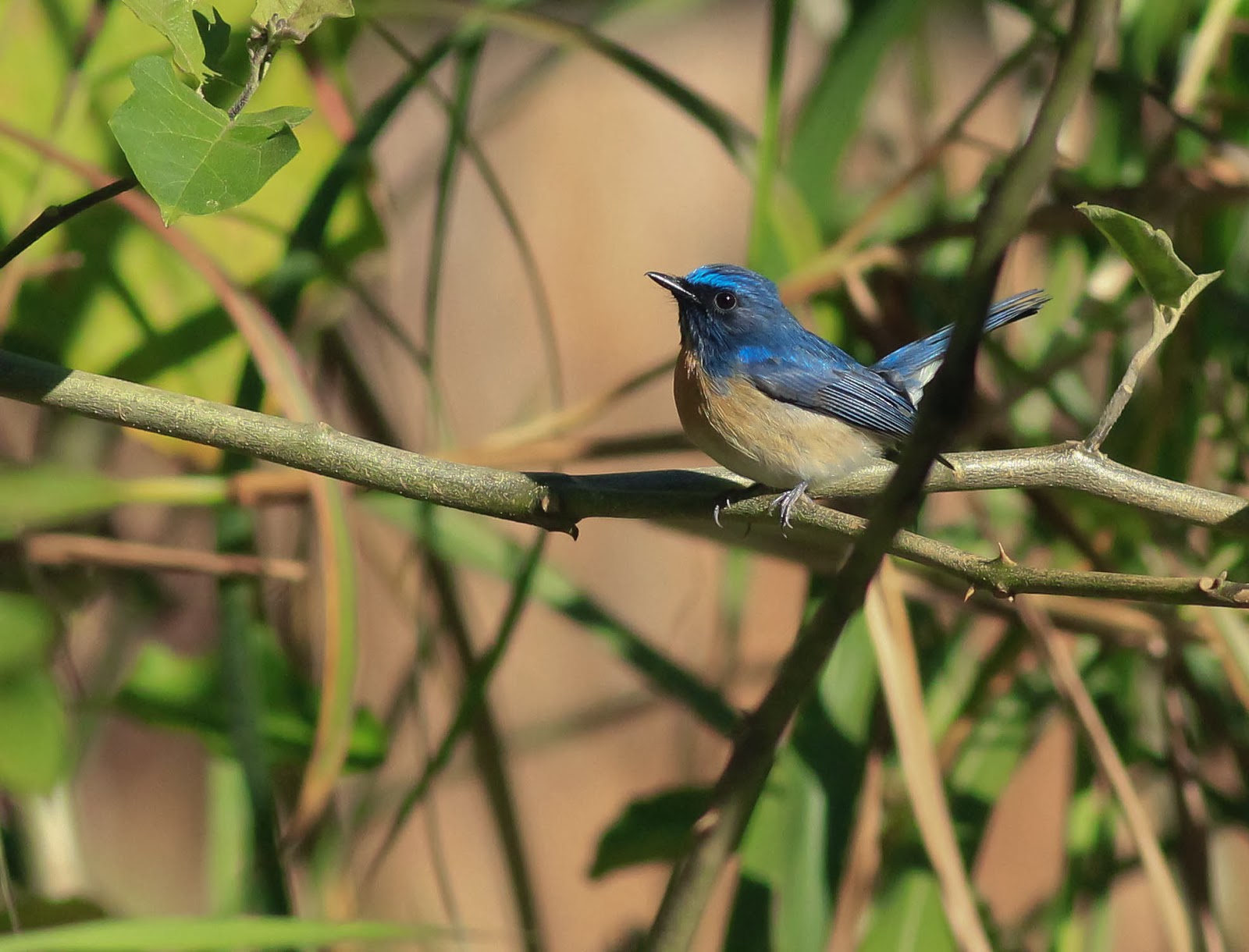
Klossi Blue-throated Flycatcher
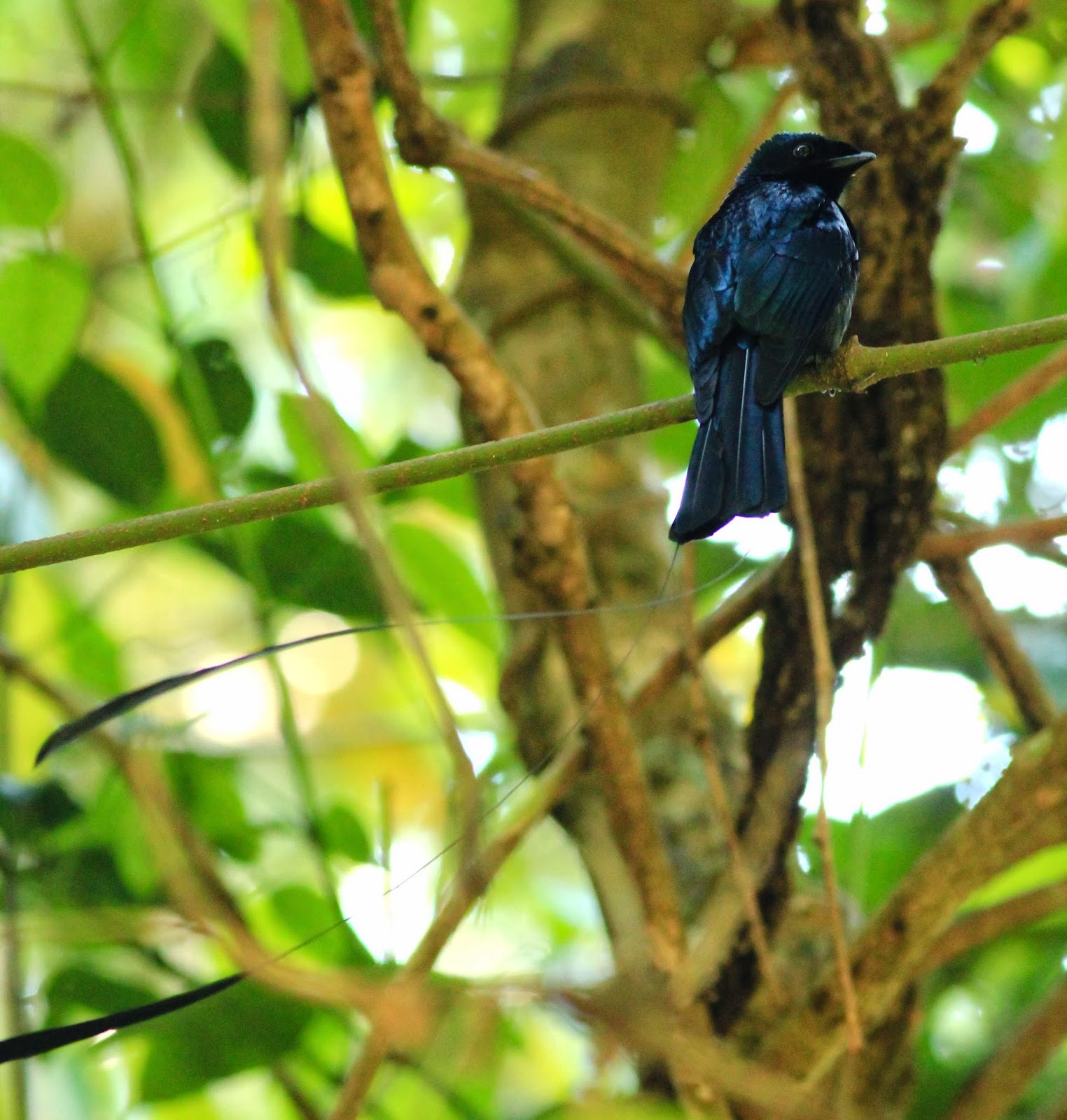
 Lesser Racket-tailed Drongo

 Bar-winged Flycatcher-Shrike

According to the caretakers, the construction work will start up again as soon as the investors raise enough money. They plan to build a hotel, a restaurant and a road at the bottom of the valley. Considering the Vietnamese conception of 'eco-tourism', looks like this is another site that might be lost in the not too distant future.

During my afternoon touristic strolls, whilst chasing flowers (hard work), I added some other interesting species notably some males of the isolated meridionalis race of Red Crossbill (potential split also), Chestnut-vented Nuthatch and Grey-crowned Tit (split from Black-throated) in pine forest on the slopes of Mount Lang Bian.
I missed Collared Laugher and Vietnamese Cutia, 2 other Vietnamese endemics; a good reason to come back there!

All in all it was an excellent trip, with fantastic birds. And I will connect with the last endemic sooner or later, watch these pages…

A quarry close to the broadleaved forest

5 September 2013

Birding in the rainy season

Hi all,

I have done recently a trip in Southern Vietnam with 2 clients. We saw 172 species in 9 days trip within Cat Tien, Di Linh and Da Lat. I though that it is not a bad result in the rainy season.

We got Siamese Fireback, Bar-bellied Pitta, Wooly-necked Stork, Grey-faced Tit Babbler, Black-crowned Parrotbill, Annam Barbet, Black-chinned Yuhina, Black-headed Sibia, Speckled and White-browed Piculets, Vietnamese Cutia, Vietnamese Greenfinch, Grey-crowned Crocias, Slaty-backed Forktail, Da Lat Shrike-Babbler, White-cheeked and White-crested Laughingthrushes, Golden-throated Barbet, Lace, Great flameback, Greater Yellownape, Black and Buff, Grey-capped Pygmy Woodpeckers, Ruby-cheeked, Brown-throated, Olive-backed, Crimson, Mrs's Gould, Black-throated Sunbirds and more...
We also spotted Asian Brown Flycatchers in all sites (22 - 30 Aug). We also heard Collared and Black-hooded Laughingthrushes, but could not see them.


Cheers!

Tien
(Guide on birding and photography): tienpitta@gmail.com

23 April 2012

Indochinese Fulvetta on Mount Bi Doup


Mount Bi Doup is the highest peak (2,287 m) in the Dalat area and home to the Indochinese Fulvetta. This little bird has not yet been seen by many birders, as it only occurs at high altitudes in places that are difficult to access (Bi Doup, Chu Yang Sin and somewhere in Laos).

Mount Bi Doup, Lam Dong Province

After several fruitless attempts to get up to the summit of Bi Doup by Richard Craik, Simon Mahood and others, I was extremely fortunate to be in Vietnam at the right time to join Luyen and Richard's latest attempt.

Luyen organised the trip with the Bi Doup Nui Ba National Park office. K'Vang from the ecotourism centre, park ranger Cuong, Tamari Kyotaka from the JICA project and a support team from the NP joined us. The plan was to start from Klong Klanh, camp just below the summit, then the following day walk over the summit and down to Bi Doup Ranger Station.

On the morning of 17.4.12 we crossed the river on narrow log bridges at Klong Klanh and soon entered nice broadleaved forest, which after one or two hours of walking showed no signs of recent logging.

Huge Fokienia trees, endemic Krempf's pines, varying rich undergrowth, branches full of moss, orchids and other epiphytes... the best forest in Vietnam I have seen so far.

Cuong climbing the 1,300 year old Fokenia

Beautiful forest

Richard's first attempt of playing Collared Laugingthrush calls produced an immediate response from the Laughers on one side of the trail and of a Blue Pitta from the other side. I went in for the pitta and quickly had good views, excellent start!

Collared Laughers remained to be present everywhere and very responsive to tape. Every single playback resulted in inquisitive Laughers coming in quickly. They seemed to be one of the commonest birds on the mountain.

After a rather pleasant and not overly steep five hour walk, we arrived at the camp site. We left the luggage and went up the final steep ascent to the summit to look for our target bird.

On the way up Luyen had good views of a Buff-cheeked Gibbon, I managed a brief glimpse before it disappeared. Several Rufous-gorgeted Flycatcher entertained us during our frequent breaks to catch our breath on the way up.

On reaching the summit we found it to be covered with 10 metre tall trees with little undergrowth, not bamboo as expected. We then searched the wider summit area and discovered the gradually descending flank of the mountain was covered with a dense understory. There we quickly found our bird: Indochinese Fulvetta, Alcippe danisi bidoupensis! Pishing brought in a pair, which gave soft calls, checked us out and then disappeared back into the thicket...

Indochinese Fulvetta (Photo by Luyen)

Shaking hands all around, relieved about our quick success, we went back to enjoy dinner prepared by the national park crew. The evening was dark with menacing clouds and distant thunder, but we were lucky and had no rain at all.

The camping was well organised, no problems with cleanliness as we seemed to be the first users of the tents and sleeping bags. The night was a little cold, lots of frogs and a Grey Nightjar were calling. The Collared Laugingthrushes did the wake-up calls and we started the day with trying to photograph them and look for other birds around the camp.

Collared Laugingthrush (Photo by Luyen)

Right next to the camp we found a nest of Black-crowned Fulvettas that were busy with feeding young.

Black-crowned Fulvetta at Nest (Photo by Luyen)

Luyen and I also thought we heard calls of Grey-crowned Crocias, at around 2,150 m, well out of their usual altitudinal range. However we did not get any response on playing their calls, so this remains somewhat unconfirmed.

After breakfast, which was accompanied by singing Gibbons, we packed up and returned to the summit.

On Bi Doup summit

There we spent two hours to look for more Indochinese Fulvettas, which we easily found among the denser undergrowth. In total we saw maybe 10 pairs. They were all in dense undergrowth and thin mossy lianas hanging down from trees.

Indochinese Fulvetta (Photo by Luyen)

Richard in the Indochinese Fulvetta's preferred habitat

The whole morning was extremely birdy, quite a change from the usual hard work that comes with birding in Vietnam. Collared Laugers were present up to the summit, Dalat and Clicking Shrike Babblers, Vietnamese Cutia, Grey-bellied Tesia, Pygmy Wren Babbler, Grey-crowned Tits, more Black-crowned Fulvettas, Kloss' and Blyth's Leaf Warblers and many more plentiful and very easy to see. Very enjoyable!

I checked out some strange sounds just below the summit that seemed to be coming from a hidden group of primates. Despite the intimidating noises I tried to get closer but couldn't get views through the dense trees. I guess they were the same group of gibbons seen the previous day.

We then walked down the gently sloping ridge and after around two hours reached pine forest (which had Vietnamese Greenfinch and the other usual species found in Dalat pine forest), another two to three hours down we arrived at the Bi Doup ranger station. There we enjoyed a late lunch of instant noodles before crossing the river on a rickety raft and driving back to Dalat in the fancy JICA Landcruisers, comfortably ending a fantastic trip.

Florian

17 April 2011

Changes in Datanla, Tuyen Lam lake and Ta Nung Valley


This winter I have experienced changes in some of the most popular places for birdwatching around Dalat. Some of you will know this already, but I give here a short summary of the changes, as I believe it will be news to some:


Ta Nung Valley: Part of the area is privatly owned, and they have started the construction of a resort. For the time being they are constructing the road (picture) down to the site where there will be a restaurant. A new fence and locked gate have been put up half way down the road leading from the main road. Since it is privat property I guess the owner is in his rights. The first time I came there (in January), a young student took me on his motorbike, but the manager did not let us in, and we simply had to return. Fortunately a new manager arrived in February, and he and his wife are very friendly. They let people in if you call down to them. I give them a small amount of money to smooth things.


Tuyen Lam lake: As mentioned previously on this blog, they are constructing a road up the slope from Da Tien restaurant to Pinhatt. This has ruined the whole scenery along the shortest trail from Da Tien to the top. However, one can of course take advantage of this, and use the road to get quick and easy access to the top.


Datanla: Some people visit this area for birdwatching. I am among those. It is a very short drive from Dalat, and surprisingly many species can be seen by walking a few metres and sitting comfortably on benches. However, it is a must to be there early in the morning, before people have scared away most of the birds! The facility has expanded, so the full "service" is now the following: Entrance fee VND 10 000, which I normally pay on my way out again, because I come in (without problems) before they open. The best area for birds is by walking slowly down to the first, big waterfall. Alternatively one can go on the rollercoaster (VND 40 000) down to the first waterfall. Recently they have constructed a cable-car (VND 40 000) that continues down a gully, and then you can go even further in an elevator (free) that takes you down to the bottom of the valley. I have not investigated the area in the bottom of the valley, because the cable-car did not run when I was there. However, this area may be good for birdwatching in the morning.


Arild

Some observations in Dalat January - April


Here are some more or less unusual sightings I did during my stay in Dalat this winter:


A Narcissus Flycatcher male (the narcissina race) visited my garden in Dalat on 9th April - a wonderfully colored bird!


While Xuan Huong lake in Dalat was almost without water (until tet), it was more suitable for waders. In addition to large numbers of Common Sandpiper (a maximum of 25+ seen when bicycling around the lake on 2nd January) and Chinese Pond Herons (a maximum of 100+ on 2nd of January), I noted 2 Little Ringed Plovers on 2nd January and 1 Pintail Snipe on 16th January. After the lake was filled with water again, I noted 2 Little Cormorants on 16th March.


In Tuyen Lam lake I saw a Darter on 11th April.


Arild

16 April 2011

Photoshots from my window in Dalat


During my stay in Dalat this "winter" I have had several bird species in the garden in the middle of Dalat, and I have been able to get some nice shots from my window. Here are some of them: Blue Rock Thrush (philippensis-race), Taiga Flycatcher, Red-whiskered Bulbul, Black Bulbul and Black-headed Sibia (I was quite surprised to see this species in the middle of town).


Arild